Google Ads Explained: Search Terms, Clicks & Wasted Spend
Last updated: 2026-10-13
Learn how to analyse Google Ads search terms, understand clicks and reduce wasted spend to improve campaign performance and maximise your budget.
Google Ads can help businesses reach customers who are actively searching for their products and services. However, generating clicks is only one part of a successful advertising strategy.
For businesses investing significant budgets in digital marketing, understanding what triggers an ad, who engages with it and what happens after the click is essential. Without that visibility, campaigns can generate traffic without producing the enquiries, sales or commercial outcomes the business needs.
This is where Google Ads reporting becomes valuable. By analysing search terms, click behaviour, conversion data and campaign performance, businesses can make more informed decisions about where their advertising budget goes and how campaigns should be improved.
At IT BOOST Australia, we approach digital marketing as more than simply generating website traffic. Effective Google Ads management requires a clear understanding of search intent, reliable measurement and a website that helps turn relevant visitors into customers.
Google Ads Keywords vs Search Terms: What's the Difference?
Keywords and search terms are closely related, but they serve different purposes in Google Ads. Understanding the distinction is an important first step towards improving campaign targeting and reducing irrelevant traffic.
Keywords are the terms advertisers select to help target their ads. Search terms are the words or phrases people actually enter into Google that may trigger those ads.
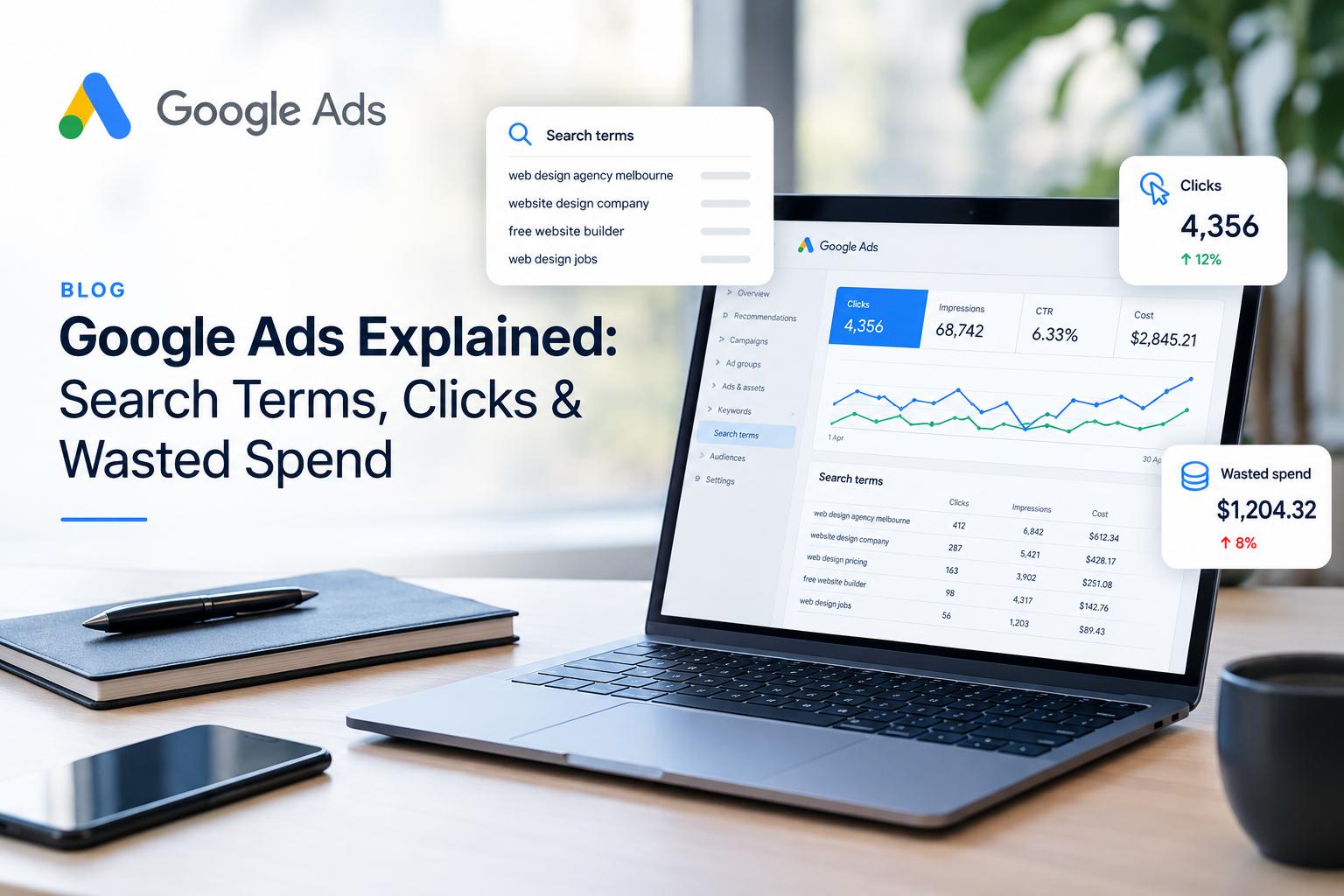
For example, a web design agency might target the keyword "web design agency". Depending on its match type and other campaign settings, its ad could appear for searches such as:
- Web design agency Melbourne
- Enterprise web design agency
- Web design agency pricing
- Free website builder
- Web design agency jobs
These searches may look similar, but they represent different levels of commercial intent. Someone looking for a professional web design agency may be a potential client, while someone searching for a free website builder or job opportunities may not fit the agency’s target audience.
The keyword determines the targeting opportunity. The search term reveals more about what the person was actually looking for.
This distinction matters because even carefully selected keywords can trigger searches that are not relevant to a business. Google Ads match types influence which searches can trigger ads, so advertisers need to review actual search behaviour rather than assuming their keyword list tells the whole story.
Who Is Clicking Your Google Ads?
Knowing how many people click an ad is useful, but it does not tell you everything about those visitors.
A click does not automatically represent a qualified prospect, a genuine sales opportunity or a future customer. Some visitors may be researching options, comparing suppliers, looking for information or searching for something your business does not provide.
Google Ads does not generally reveal the personal identity of each individual who clicks an advertisement. Instead, it provides reporting data that helps advertisers understand traffic patterns and evaluate campaign performance.
Businesses can examine several areas to build a clearer picture.
Search intent
Search terms can indicate what people are looking for when an ad appears. Searches containing words such as pricing, supplier, enterprise solution or near me can suggest different needs, although intent should always be assessed in context.
Understanding these patterns helps businesses determine if their campaigns are reaching people whose needs align with their offerings.
Location and device
Location and device reports can help identify where ad interactions occur and which devices generate engagement or conversions.
For a business targeting corporate clients in specific Australian cities, this information can help assess geographic relevance. Device data can also reveal potential issues with mobile landing pages or differences in how visitors engage across desktop and mobile experiences.
Audience and demographic insights
Depending on the campaign type, available data and reporting thresholds, Google Ads may provide aggregated audience, demographic and other segment insights.
These reports can help identify broader patterns, but they should not be treated as a personal identification tool. Not every visitor can be identified, and not every campaign provides the same level of detail.
Conversion behaviour
Conversion tracking provides a more commercially useful view of campaign performance. It can help measure actions such as completed enquiry forms, phone calls, purchases or other defined business outcomes.
For businesses focused on lead generation, the next step is to distinguish between an enquiry and a qualified opportunity. A campaign that generates fewer enquiries may still deliver greater commercial value if those enquiries are more relevant and more likely to become customers.
The goal is not simply to understand who clicked. It is to understand which traffic contributes to meaningful business outcomes.
How to Identify Wasted Spend in Google Ads
Wasted spend can occur when ads reach people whose searches, needs or locations do not align with the business. It can also occur when relevant visitors reach a website that fails to convert them.
A structured review helps separate these problems.
Review irrelevant search terms
Start by identifying searches unrelated to your products or services. Depending on your business, these may include job searches, free alternatives, training queries or services you do not offer.
Where appropriate, add negative keywords to prevent ads from showing for irrelevant searches. Negative keywords need careful management because excluding a term too broadly can also block valuable traffic.
Assess keyword match types
Review how your keyword match types are performing and what kinds of searches they attract. Broad match can help uncover relevant searches beyond the exact wording of your keywords, but it requires appropriate campaign settings, conversion measurement and ongoing monitoring.
The objective is not to eliminate all variation. It is to ensure that the additional reach supports your business goals.
Check geographic targeting
If your business only serves particular locations, review the campaign's location settings and location reports. Google Ads location options can affect who is eligible to see your ads, so the configuration should reflect the actual areas your business serves.
Investigate unusual click patterns
A sudden increase in clicks, high costs without corresponding engagement or repeated low quality enquiries may warrant further investigation. These patterns alone do not prove invalid traffic.
Google automatically filters many invalid clicks, including certain accidental, duplicate and automated interactions. Advertisers can review invalid click metrics and investigate persistent concerns through Google's available support processes.
Review the landing page
Not every underperforming campaign has a targeting problem. Relevant visitors may leave because the landing page is slow, confusing, poorly matched to the ad or difficult to use on mobile devices.
Check that the page answers the visitor's question, clearly communicates your offering and provides a straightforward next step. Advertising performance depends on the entire journey, not just the ad itself.
Beyond Clicks: Measure What Matters to Your Business
Clicks, impressions and click through rate help explain how people interact with your ads. However, they should not be the only measures used to evaluate campaign success.
For established businesses, reporting should connect advertising activity to outcomes that matter commercially.
Depending on the business model, useful metrics may include:
Conversion rate: The proportion of measured ad interactions that result in a defined conversion.
Cost per conversion: How much advertising spend is associated with each recorded conversion.
Qualified lead rate: The proportion of enquiries that meet your sales team's requirements.
Cost per qualified lead: The advertising cost associated with generating a suitable sales opportunity.
Conversion value and revenue: The value attributed to purchases or other measurable business outcomes, where reliable tracking is available.
These metrics need to be interpreted together. A low cost per lead may look attractive, but it becomes less meaningful if most enquiries are irrelevant. Similarly, a campaign with a higher cost per acquisition may still be worthwhile if it consistently attracts more valuable customers.
Reliable conversion tracking is essential to this process. If forms, phone calls, purchases or other important actions are not tracked correctly, campaign reports may provide an incomplete picture of performance. For businesses using automated bidding, conversion measurement can also influence how Google's systems optimise campaigns.
Larger organisations may need to connect advertising data with CRM records, sales outcomes and revenue reporting to understand the full customer acquisition journey. This requires a considered measurement framework, not simply adding a conversion tag and assuming every recorded action has equal value.
Why Search Term Analysis Matters for Larger Businesses
For businesses managing multiple services, locations, product categories or advertising campaigns, search term analysis becomes an ongoing management task rather than an occasional account check.
A campaign structure that works for one service or market may not suit another. Search intent, customer value and competitive conditions can vary significantly across business units and locations.
A structured optimisation process helps marketing teams identify patterns across their accounts, allocate budgets more effectively and maintain control as campaigns expand.
For example, a national business may advertise several services across multiple Australian cities. Reviewing search terms can reveal that one campaign is attracting high intent enquiries, while another is spending heavily on searches that rarely produce suitable leads.
The appropriate response might involve refining negative keywords, improving landing pages, changing campaign segmentation or reassessing budget allocation. The decision should be based on the evidence available and the commercial objectives of each campaign.
Consistency also matters. Establishing regular reporting, clear conversion definitions and documented optimisation processes helps internal marketing teams and external agencies work towards the same objectives.
For enterprise level advertising, the goal is not simply to manage more campaigns. It is to maintain visibility, measurement quality and strategic control as advertising activity becomes more complex.
How IT BOOST Australia Helps Improve Google Ads Performance
At IT BOOST Australia, we approach digital marketing through the relationship between advertising, website performance, SEO and the customer journey. Each component influences the value businesses can obtain from their digital investment.
We calibrate your Google Ads campaigns to work smarter, not harder, aligning your targeting, budget allocation and bidding strategy with your business goals. By focusing on relevant search traffic and meaningful conversion data, we help make better use of your advertising budget and generate higher quality leads, rather than simply chasing more clicks.
We also consider the website experience that follows each click, including landing page relevance, mobile usability and the clarity of the next step. Our work across web design, custom web development and SEO also allows us to consider issues beyond the advertising account itself. If campaigns attract relevant traffic but the website fails to convert visitors, improving the landing page or underlying website experience may be just as important as changing the campaign settings.
For businesses with more complex requirements, this can include reviewing how campaign reporting aligns with lead quality, sales processes and broader business objectives.
We focus on practical improvements supported by data, with the goal of building a more efficient, measurable Google Ads strategy that makes better use of your budget and supports sustainable business growth.
Make Your Google Ads Investment Work Smarter
Understanding search terms, clicks and wasted spend is an important part of managing Google Ads effectively. It helps businesses identify irrelevant traffic, discover useful search opportunities and evaluate whether campaigns are contributing to meaningful outcomes.
For businesses investing in Google Ads, a more disciplined approach to measurement and optimisation can provide greater visibility into performance and help identify opportunities to improve efficiency.
Looking to improve your Google Ads performance? IT BOOST Australia can help you assess your campaigns, strengthen your tracking and build a digital strategy around your business goals.
Contact IT BOOST Australia to discuss your Google Ads management and broader digital marketing requirements.
Disclaimer
This article is provided free of charge for public information. We do not guarantee, and accept no legal liability for, the accuracy, reliability, currency, or completeness of the content or any linked material. Users should apply their own judgment and verify the material’s relevance to their needs. This article is a general summary and not a substitute for legal or professional advice. Users should seek appropriate advice for their circumstances. Any third-party views expressed do not necessarily reflect ours or imply endorsement.
Terminologies used in this article
- Campaign Performance
- Campaign performance measures how well an advertising campaign achieves its goals. It is typically evaluated using metrics such as clicks, conversions, impressions, and return on investment (ROI).
- Conversion
- A conversion is a valuable action completed by a user, such as making a purchase, submitting a contact form, or signing up for a service. Businesses use conversions to measure the success of their marketing efforts.
- Digital Marketing
- Digital marketing is the promotion of products or services through online channels such as search engines, websites, social media, email, and paid advertising. It helps businesses reach and engage with potential customers using digital technologies.
- Keyword
- A keyword is a word or phrase that advertisers target so their advertisements can appear when users search for related topics. Choosing relevant keywords helps businesses reach the right audience.
- Landing Page
- A landing page is a standalone webpage created for a specific marketing campaign or business objective. It is designed to encourage visitors to complete a particular action, such as making an enquiry or purchasing a product.
- Lead Generation
- Lead generation is the process of attracting potential customers who have shown interest in a business's products or services. Common methods include online advertising, SEO, and contact forms.
- Mobile Usability
- Mobile usability refers to how easy a website is to use on smartphones and tablets. A website with good mobile usability provides clear navigation, readable content, and a smooth browsing experience across different screen sizes.
- Search Intent
- Search intent is the purpose behind a user's search query. Understanding search intent helps businesses create content that better matches what users are looking for.
- Search Term
- A search term is the exact word or phrase that a user types into a search engine. It may differ from the keywords an advertiser has selected for their campaigns.