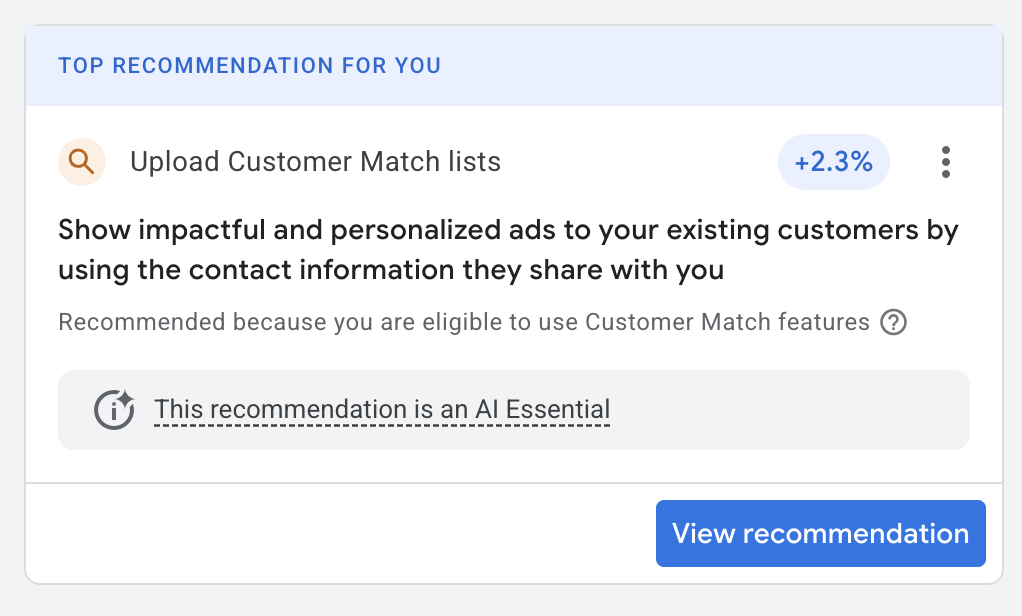
Is Uploading Customer Match Lists Worth It for Google Ads?
Last updated: 2026-05-05
Customer Match Lists can improve Google Ads targeting and efficiency, but they also introduce privacy and data management considerations.
As Google Ads become increasingly driven by automation and machine learning, businesses are being encouraged to provide more first-party data to improve campaign performance.
For many businesses, especially those investing heavily into digital advertising, Customer Match can improve targeting precision, reduce wasted spend, and help Google better understand what a valuable customer looks like. At the same time, it introduces additional responsibilities around data management, privacy, and ongoing maintenance.
The question is no longer simply “Should you upload customer lists?” It’s whether the benefits outweigh the operational and compliance considerations for your business.
What Is Customer Match?
Customer Match List in Google Ads allows businesses to upload customer information such as:
- Email addresses
- Phone numbers
- Mailing addresses
Google then attempts to match this information with signed-in Google users. Once matched, businesses can:
- Retarget existing customers
- Exclude current customers from campaigns
- Improve Smart Bidding performance
- Build audience signals for prospecting campaigns
Customer Match works across multiple Google properties including:
- Search
- YouTube
- Gmail
- Display
This gives advertisers broader reach while maintaining more precise audience targeting.
The Benefits of Uploading Customer Match Lists
Better Audience Targeting
One of the biggest advantages of Customer Match is the ability to target users who already know your business.
These users may include:
- Existing customers
- Previous enquiries
- Past leads
- Inactive customers
Since these audiences already have some level of familiarity with your brand, they are often more likely to convert compared to completely cold traffic.
For businesses running long-term campaigns, this creates stronger re-engagement opportunities and improves conversion efficiency.
Improved Smart Bidding Performance
Google’s Smart Bidding systems rely heavily on data signals.
Uploading Customer Match lists provides Google’s AI with a clearer “seed audience” to optimise around. This helps Google identify:
- Which users are more valuable
- Which behaviours correlate with conversions
- Which audiences are worth bidding more aggressively on
For enterprise-level campaigns, this can improve:
Return on ad spend (ROAS)
- Conversion quality
- Lead consistency
- Budget efficiency
As automation continues to expand within Google Ads, first-party data is becoming increasingly important.
Better Exclusion Control
One of the most overlooked benefits of Customer Match is exclusion targeting.
Without exclusions, businesses often waste advertising budget showing acquisition ads to:
- Existing customers
- Current leads
- Staff members
- Recent conversions
Customer Match allows advertisers to remove these users from specific campaigns.
For example:
- A flooring company can exclude recent leads for 30 days
- An automotive business can exclude recent purchasers
- A physio clinic can avoid targeting existing patients with introductory offers
This helps ensure acquisition budgets remain focused on genuinely new prospects.
Similar Audience Expansion
Google can also use uploaded lists as signals to find new users who behave similarly to your best customers.
This is particularly useful for:
- Scaling campaigns
- Finding higher-quality audiences
- Improving prospecting performance
Rather than relying entirely on broad targeting, Google can use customer data to guide optimisation more intelligently.
For businesses with strong customer databases, this can significantly improve lead quality over time.
Cross-Platform Advertising Benefits
Customer Match is not limited to Search campaigns.
It can also be used across:
- YouTube advertising
- Gmail promotions
- Display campaigns
- Performance Max campaigns
This allows businesses to create more cohesive multi-channel strategies while maintaining targeting consistency.
The Downsides of Customer Match
Despite its benefits, Customer Match also comes with several important considerations.
Privacy and Compliance Responsibilities
Businesses uploading customer data must ensure they comply with:
- Google’s advertising policies
- Australian Privacy Act requirements
- Consent and data handling obligations
Improper handling of customer data can create compliance risks and, in some cases, account restrictions.
Businesses should ensure:
- Customer consent processes are clear
- Privacy policies are updated
- Data storage practices are secure
As privacy expectations continue to increase globally, these responsibilities are becoming more important.
Match Rate Limitations
Not every email or phone number will successfully match a Google account.
Typical match rates can vary significantly, often landing between 30% and 60%. This means a large portion of uploaded data may not actually become usable audiences.
For smaller businesses with limited databases, this can reduce effectiveness.
Ongoing Data Maintenance
Customer Match is not a “set and forget” feature. The lists require regular maintenance to remain effective:
- Old contacts should be removed
- New leads should be added
- Databases should stay clean and organised
Outdated or messy lists reduce match rates and weaken campaign performance. Additionally, Google now places greater emphasis on secure data handling processes.
Restrictive Minimum Requirements
Certain Customer Match features are not always available to smaller advertisers.
In some cases, businesses may require:
- Higher historical ad spend
- Larger audience sizes
- Minimum matched user thresholds
Google generally requires at least 1,000 matched users before lists become active.
For small businesses with limited customer data, the impact may therefore be reduced.
What If You Don’t Upload Customer Match Lists?
Some businesses choose to rely entirely on Google’s automated targeting instead.
Advantages to this approach include:
- Simpler campaign management
- Lower maintenance overhead
- Reduced privacy handling concerns
- Less technical complexity
However, there are also trade-offs.
Without Customer Match:
- Google has less audience data to optimise from
- Campaigns may take longer to stabilise
- Existing customers may continue seeing acquisition ads
- Personalisation opportunities become limited
Essentially, Google’s AI has fewer signals to work with.
Should Your Business Use Customer Match?
Not every business will benefit from Customer Match in the same way. The effectiveness of uploaded customer lists often depends on factors such as database size, advertising budget, sales cycle length, and campaign maturity.
For some businesses, Customer Match can significantly improve efficiency and lead quality. For others, the impact may be minimal compared to improving website performance, tracking, or campaign structure first.
Large & Enterprise Businesses
For larger businesses and enterprise advertisers, Customer Match is generally considered a best practice.
The ability to:
- Improve targeting
- Exclude existing customers
- Strengthen Smart Bidding
- Enhance audience expansion
can all contribute to more efficient advertising performance.
Medium-Sized Businesses
For medium-sized businesses, Customer Match often becomes far more valuable.
Medium businesses typically have:
- Larger lead databases
- More consistent monthly enquiries
- Ongoing advertising campaigns
- Better-defined customer segments
This creates stronger opportunities to:
- Improve Smart Bidding performance
- Reduce wasted spend
- Build segmented audiences
- Re-engage past leads
Medium-sized businesses also tend to benefit more from audience exclusions, especially when running acquisition-focused campaigns.
Small Businesses
For smaller businesses with limited customer data, Customer Match may not always deliver immediate value.
Since Google generally requires around 1,000 matched users before a list becomes active, smaller businesses may struggle to reach the minimum threshold.
In these cases, small businesses are often better off focusing on:
- Strong website performance
- Clear landing pages
- Proper conversion tracking
- Local SEO
- Basic Google Ads optimisation
That said, Customer Match can still be useful for:
- Local remarketing
- Excluding existing customers
- Re-engaging previous enquiries
For small businesses, it should usually be viewed as a supporting tool rather than a primary strategy.
A Smarter Approach to Google Ads
Customer Match can provide a meaningful advantage for businesses looking to improve campaign efficiency and reduce wasted spend. However, businesses also need to understand the operational responsibilities that come with it.
As Google continues evolving toward AI-driven advertising, businesses that maintain clean data, strong infrastructure, and integrated digital strategies will be in a stronger position to compete long-term.
If your Google Ads campaigns aren’t delivering the results they should, IT BOOST Australia can help build a more targeted, data-driven strategy focused on long-term growth and better return on ad spend.
Disclaimer
This article is provided free of charge for public information. We do not guarantee, and accept no legal liability for, the accuracy, reliability, currency, or completeness of the content or any linked material. Users should apply their own judgment and verify the material’s relevance to their needs. This article is a general summary and not a substitute for legal or professional advice. Users should seek appropriate advice for their circumstances. Any third-party views expressed do not necessarily reflect ours or imply endorsement.
Terminologies used in this article
- Audience Signals
- Audience signals are pieces of information provided to Google's AI to help it better understand the type of customers a business wants to reach. These signals improve automated targeting by identifying users who are more likely to convert.
- Australian Privacy Act
- The Australian Privacy Act is legislation that regulates how organisations collect, use, store, and disclose personal information. Businesses handling customer data must comply with this law to protect individual privacy and meet legal obligations.
- Campaign Performance
- Campaign performance measures how well an advertising campaign achieves its goals. It is typically evaluated using metrics such as clicks, conversions, impressions, and return on investment (ROI).
- Conversion
- A conversion is a valuable action completed by a user, such as making a purchase, submitting a contact form, or signing up for a service. Businesses use conversions to measure the success of their marketing efforts.
- Customer Match
- Customer Match is a Google Ads feature that allows businesses to upload customer information, such as email addresses or phone numbers, to create targeted audiences. Google securely matches this data with signed-in users, enabling businesses to reach existing customers or improve campaign targeting.
- First-Party Data
- First-party data is information collected directly by a business from its own customers or website visitors through interactions such as purchases, enquiries, or website visits.
- Return on Ad Spend (ROAS)
- Return on Ad Spend (ROAS) is a marketing metric that measures how much revenue is generated for every dollar spent on advertising. It helps businesses evaluate the effectiveness and profitability of their advertising campaigns.
- Seed Audience
- A seed audience is a group of existing customers or users that provides a starting point for Google's AI to identify similar potential customers. It helps improve audience targeting and campaign optimisation.
- Smart Bidding
- Smart Bidding is a Google Ads feature that uses artificial intelligence (AI) and machine learning to automatically adjust bids in real time. Its goal is to help businesses achieve better advertising results, such as increasing conversions or improving return on investment.
- Website Performance
- Website performance refers to how efficiently a website loads, responds, and functions for users. Factors such as page speed, stability, and responsiveness all contribute to overall website performance.